


Holset Variable Geometry Turbochargers
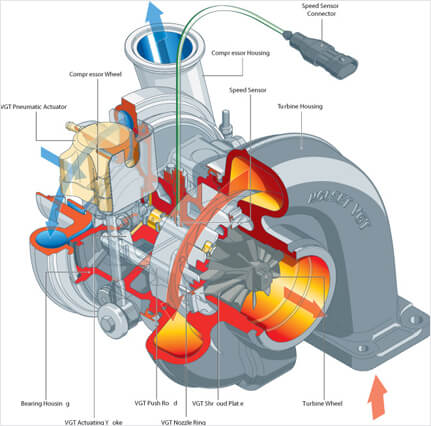 The key to turbocharging is to maximize and control the boost pressure over as wide a field of engine operation as possible. Holset patented VGT™ technology gives infinite control of boost pressure.
 The Holset VGT uses a turbine stage where the swallowing capacity is automatically varied while the engine is running. This permits turbine power to be set, providing sufficient energy to drive the compressor at the desired boost level wherever the engine is operating. This is achieved by varying the area of the nozzle; a set of guide vanes that control the flow of exhaust gas through the turbine.
Conventional designs pivot the vanes to achieve different nozzle areas. The Holset VGT is extraordinary in that the vanes do not pivot but slide axially; this design ensures a high level of durability and reliability, essential for today's commercial diesel applications. In addition, the vanes are fixed in an optimum position that creates the most favorable angle of incidence of the exhaust gas onto the turbine wheel blades thus raising average turbine efficiency throughout its operating range.
The sliding nozzle ring alters the aperture through which the exhaust gases flow onto the turbine wheel. This alteration in the geometry of the turbocharger increases the boost as the nozzle is closed down. Reducing the aperture increases exhaust manifold pressure and increases the turbocharger speed. As the nozzle ring opens up, the exhaust pressure reduces and the turbocharger boost can decrease; or simply maintain ideal boost levels as the aperature increases to raise the turbine's exhaust swallowing capacity to compensate for increasing engine r.p.m. In effect it creates an infinite number of fixed geometry turbochargers.
Benefits of Holset VGT - In Summary
- Good transient response
- Improved fuel economy
- Increased useful engine operating speed range
- Enhanced compression brake capability
- Proven durable design
- Reduced engine swept volume and package size for a given rating
- Helps control Exhaust Gas Recirculation (EGR) to meet emissions regulations
Pneumatic or Electric Actuation
The Holset VGT is part of a totally integrated fuel and air control system controlled by the engine electronics. Either electric or pneumatic actuation can be used to regulate the turbocharger's nozzle geometry. Pneumatic actuation harnesses air pressure from the vehicle braking system. Alternatively a water cooled and automatically calibrated electric motor actuator makes for a simplified installation while maintaining responsiveness and overall turbocharger performance.
It's Got To Be Holset
Holset Turbochargers are the only manufacturer that focuses solely on medium to heavy-duty diesel engine turbo technologies.

Genuine Products
With thousands of dollars at stake every minute, equipment uptime is critical. So you can't afford to take the risk of using non-genuine parts.
Genuine Parts
Genuine Holset new and reman parts include the latest upgrades in materials, component design and workmanship. So you aren't just replacing a worn part - you're improving the performance of your engine and your equipment.
Quality Standards
Holset turbos are made to highly specific standards, not only to deliver the power owners demand, but also to keep diesel engines performing at top efficiency year after year.
Genuine Reliability
Today's top diesel trucks work at the molecular level to atomize fuel with finely tuned air and fuel pressure maximizing fuel efficiency, while it's component parts are performance matched to control emissions. That is why using the correct replacement parts is more important today than ever before.
